第1章 内容要求
Chapter 1: Content Requirement
来华留学生可以用英文撰写学位论文,但须有详细中文摘要(不少于6000字),英文摘要300-800英文实词。
International students can write degree thesis in English, but there must be a detailed Chinese abstract (no fewer than 6,000 characters) and an English abstract of 300-800 substantive English words.
学位论文一般由以下几部分组成,依次为:
Degree thesis are usually consisted of the following parts:
1.中文封面;Chinese cover page (Appendix 12)
2.中文题名页;Appendix 1: Chinese title page
3.英文题名页;Appendix 2: English title page
4.学位论文原创性声明;Appendix 3: Originality statement
5. 研究生学位论文导师承诺书;Appendix 4: Supervisor statement
6.学位论文使用授权书;Appendix 5: Using authorization
7.作者简介;Appendix 6: Author’s Resume
8. 学位论文答辩委员会名单;Appendix 7: The list of Degree‑Thesis Defense Committee Members
9.中文摘要; Appendix 8: Chinese Abstract
10.Abstract;English Abstract
11.目录; Appendix 8: Contents
12.图和表清单(如有); Appendix 9: Figure and chart list (if you have)
13.正文; Main body
14.参考文献; Appendix 11: References
15.致谢; Acknowledgment
16.附录。Attachment if you have
1.1 中文封面 Chinese cover page
封面是学位论文的外表面,对论文起装潢和保护作用,并提供相关的信息。我校申请博士、硕士、硕士专业学位(全日制)和硕士专业学位(非全日制)的学位论文封面分别使用统一规定的不同封面。封面中除已固定的内容外,其他需要填写的内容要求如下:
分类号:采用《中国图书馆分类法》(第4版)或《中国图书资料分类法》(第4版)标注。
UDC:按《国际十进分类法》进行标注(可登陆www.udcc.org,点击outline进行查询)。
密级:按GB/T 7156-2003《文献保密等级代码与标识》标注。公开论文可以标注“公开”,也可不标注。根据《中国地质大学博士、硕士学位论文定密工作办法》的规定,非公开论文须经申请、批准方能标注论文的密级,同时还应注明相应的保密年限,如“保密★2年”。
论文题目:应以简明词语恰当、准确地反映出论文最重要的特定内容,一般不宜超过25字,必要时可加论文副标题。
论文题目通常由名词性短语构成,应尽量避免使用不常用缩略词、首字母缩写字、字符、代号和公式等。
如论文题目内容层次很多,难以简化时,可采用论文题目和论文副标题相结合的方法,其中副标题起补充、阐明题目的作用。
学科专业/专业学位类别:一级学科/专业学位类别名称以国务院学位委员会、教育部2022年颁发的《研究生教育学科专业目录(2022年)》为准,二级学科名称参考2024年颁布的《研究生教育学科专业简介及其学位基本要求》填写,自设二级学科按各单位向教育部备案的自设二级学科名称及代码填写。
《研究生教育学科专业简介及其学位基本要求》详见(https://www.acge.org.cn/encyclopediaFront/enterEncyclopediaIndex)
学号:填写研究生学号。
姓名:填写研究生姓名。
指导教师和企业导师:填写导师姓名,后附导师职称“教授”、“研究员”等,一般只写一名指导教师。经正式批准、备案的副导师或企业导师,写在副指导教师或企业导师一项中(限一名),后附职称“教授”、“研究员”等。
培养单位:指学位申请人所在学院(所、室、中心等)名称,应采用规范全称。如地球科学学院、资源学院等。
论文完成时间
填写论文完成时间年月,如二O二五年五月。
The cover serves as the outer face of a degree thesis. It decorates and protects the thesis and provides relevant information. Standard‑specified distinct covers shall be used for doctoral theses, master’s academic theses, full‑time professional master’s degree theses, and part‑time professional master’s degree theses submitted at our university. Except for pre‑fixed content on the cover, requirements for other fill‑in items are as follows:
**CLC Classification Number**: Marked in accordance with *Chinese Library Classification (4th Edition)* or *Chinese Literature Classification (4th Edition)*.
**UDC**: Marked according to the *Universal Decimal Classification*. (Queries can be made at [www.udcc.org](https://www.udcc.org) by clicking “outline”.)
**Security Classification**: Marked in compliance with GB/T 7156‑2003, *Codes and Identifiers for Document Security Classification*. For non‑classified theses, “Open” may be marked or this field may be left blank. In accordance with the *Measures for Security Classification of Doctoral and Master’s Degree Theses of China University of Geosciences*, security classification for non‑open theses is subject to application and official approval. The corresponding security period shall also be indicated, e.g. “Confidential ★ 2‑year”.
**Thesis Title**: Concise wording shall be adopted to accurately reflect the most essential specific content of the thesis. The title should generally not exceed 25 Chinese characters. A subtitle may be added when necessary.
A thesis title is normally formed by nominal phrases. Obscure abbreviations, initialisms, symbols, codes and formulas shall be avoided as far as possible.
Where the content of a thesis is multi‑layered and difficult to simplify, a main title combined with a subtitle may be adopted. The subtitle functions to supplement and clarify the main title.
**Discipline & Major / Professional Degree Category**: Names of first‑level disciplines and professional degree categories shall follow the *Catalogue of Disciplines and Majors for Postgraduate Education (2022)* issued by the Academic Degrees Committee of the State Council and the Ministry of Education in 2022. Names of second‑level disciplines shall be filled out with reference to the *Profiles of Postgraduate Disciplines & Majors and Basic Degree Requirements* issued in 2024. Self‑established second‑level disciplines shall use the names and codes filed with the Ministry of Education by respective institutions.
The *Profiles of Postgraduate Disciplines & Majors and Basic Degree Requirements* is available at:
https://www.acge.org.cn/encyclopediaFront/enterEncyclopediaIndex
**Student ID**: Enter the postgraduate student ID number.
**Author’s Name**: Enter the full name of the postgraduate student.
**Supervisor and Enterprise‑based Supervisor**: Fill in the supervisor’s name followed by academic title such as “Professor”, “Research Professor”, etc. Normally only one principal supervisor is listed. Formally approved and filed associate supervisors or enterprise‑based supervisors shall be listed under Associate Supervisor or Enterprise‑based Supervisor (one person maximum), followed by academic titles such as “Professor”, “Research Professor”, etc.
**Training Unit**: Refers to the official full name of the school (institute, laboratory, center, etc.) where the degree candidate is affiliated, e.g. School of Earth Sciences, Faculty of Earth Resources.
**Thesis Completion Date**:
Enter the year and month of thesis completion, e.g. May 2025.
1.2 题名页 Title page
题名页包含论文全部书目信息,单独成页(见附件1、附件2)。主要内容规定如下:
学校代码:
按照教育部批准的学校代码标注,应为“10491”。
研究生学号:
填写学生学号。
学位授予单位名称和学位论文类型:
保持“中国地质大学”题字不变。根据学位论文类型填写“硕士学位论文”或“博士学位论文”或“硕士专业学位论文(全日制)或“硕士专业学位论文(非全日制)”。
题名(即论文题目)和副题名(即论文副标题):
题名要求同论文题目,应中英文对照。英文题名在中文题名下方。
题名和副题名在整篇学位论文中的不同地方出现时,应保持一致。
责任者;
责任者包括论文作者姓名,指导教师姓名、职称等。
如责任者姓名有必要附注汉语拼音时,遵照GB/T 16159-1996《汉语拼音正词法基本规则》著录。
学科专业:同1.1中说明。
专业学位类型(领域):同1.1中说明。
培养单位:同1.1中说明。
论文完成时间:
填写论文完成时间年月,如二O二四年十二月。
The title page contains all bibliographic information of the thesis and shall be a separate page (see Appendix 1 and Appendix 2). Specifications for key items are set out below:
University Code:
Indicate the university code approved by the Ministry of Education, which shall be “10491”.
Postgraduate Student ID:
Fill in the student’s ID number.
Name of Degree‑awarding Institution & Type of Degree Thesis:
Keep the printed title “China University of Geosciences” unchanged. According to the thesis type, select one of the following: *Master’s Degree Thesis*, *Doctoral Degree Thesis*, *Full‑time Professional Master’s Degree Thesis*, or *Part‑time Professional Master’s Degree Thesis*.
Title (main thesis title) and Subtitle:
The main title shall be identical to the thesis title and presented in both Chinese and English. The English title shall be placed below the Chinese title.
Consistency of title and subtitle must be maintained wherever they appear throughout the degree thesis.
Responsible Parties:
Responsible parties include the name of the thesis author, as well as the name and academic title of the supervisor.
Where Pinyin transliteration of names is required, it shall follow GB/T 16159‑1996, *Basic Rules for Hanyu Pinyin Orthography*.
Discipline & Major: Refer to Section 1.1.
Professional Degree Type (Field): Refer to Section 1.1.
Training Unit: Refer to Section 1.1.
Thesis Completion Date:
Fill in the year and month of thesis completion, e.g. December 2024.
1.3 研究生学位论文原创性声明 Originality statement
本部分放在题名页之后另起页(见附件3)。提交时须有作者亲笔签名。
This section is placed on a new page after the title page (see Appendix 3). The submission must include a handwritten signature from the author.
1.4 导师承诺书 Supervisor statement
本部分放在研究生学位论文原创性声明之后另起页(见附件4),提交时须有论文指导教师亲笔签名。
This section should be placed after the originality declaration of the Thesis on a new page (see Appendix 4). Upon submission, it must include the thesis supervisor's handwritten signature.
1.5 学位论文使用授权书 Using authorization
本部分放在学位论文原创性声明之后另起页(见附件5),提交时须有作者亲笔签名。
This section should be placed on a new page after the originality declaration of the thesis (see Appendix 5). Upon submission, it must include the author's handwritten signature.
1.6 作者简介 Author’s Resume
个人简介包括出生年月日、获得学士、硕士学位的学校、时间等;学术论文研究成果按发表的时间顺序列出(已发表的列在前面,已接收待发表的放在后面);研究成果可以是在学期间参加的研究项目、申请的专利或获奖等(见附件6)。
The personal introduction section of the thesis includes the author's birthdate, the schools where degrees were obtained, and other academic details. It should also list academic research papers in chronological order, with already-published ones first and those that have been accepted but not yet published placed after. Additionally, research achievements during the study period, such as participating in research projects, patent applications, or awards, should be mentioned, referencing Appendix 6.
1.7 学位论文答辩委员会名单 The list of Degree‑Thesis Defense Committee Members
为进一步完善我校学位论文质量保障体系,要求学位申请人在提交归档学位论文的电子版和纸质版时,将答辩委员会名单组成编在中文摘要之前,作为研究生学位论文的组成部分(见附件7)。
To further improve the university’s quality assurance system for dissertations, degree applicants are required to include the membership list of the defense committee **before the Chinese abstract** when submitting both electronic and hard‑copy versions of their dissertations for archiving. This shall be an integral component of the postgraduate degree dissertation (see Appendix 7).
1.8 中文摘要 Chinese Abstract
中文摘要是论文内容的简要陈述,是一篇具有独立性和完整性的短文,一般以第三人称语气写成,不加评论和补充的解释。摘要具有自含性,即不阅读论文的全文,就能获得必要的信息。摘要的内容应包括与论文等同的主要信息,供读者确定有无必要阅读全文,也可供二次文献采用。摘要一般应说明研究工作的目的、研究方法、研究成果和结论,要突出本论文的创造性成果。
The Chinese abstract is a concise statement of the paper's content, serving as a standalone and complete short text. It is typically written in the third-person narrative without additional commentary or supplementary explanations. The abstract is self-contained, meaning that readers can obtain essential information without reading the entire paper. The content of the abstract should include the primary information equivalent to the paper, allowing readers to determine whether it is necessary to read the full text. It can also be utilized by secondary literature. Generally, the abstract should elaborate on the purpose of the research, the research methods, the research findings, and the conclusions, with a particular emphasis on highlighting the innovative contributions of the paper.
中文摘要力求语言精炼准确,篇幅以一页为宜。如需要,字数可以略多。
Chinese abstracts aim for concise and accurate language and are preferably limited to one page. If necessary, the word count may be slightly higher.
用外文撰写学位论文时,中文摘要应不少于6000字。
When writing a thesis in a foreign language, the Chinese abstract should be at least 6,000 Chinese characters.
摘要中不可出现图、表、化学方程式、非公知公用的符号和术语。
The abstract must not contain figures, tables, chemical equations, or non-publicly known symbols and terms.
关键词在摘要内容后另起一行标明,一般3~5个,之间用分号分开。关键词是为了便于做文献索引和检索工作而从论文中选取出来用以表示全文主题内容信息的单词或术语,应体现论文特色,具有语义性,在论文中有明确出处。应尽量采用《汉语主题词表》或各专业主题词表提供的规范词。
Keywords should be listed on a new line following the abstract content, generally 3–5 in number, separated by semicolons. Keywords are words or terms selected from the paper to represent the main content information of the entire text, intended to facilitate literature indexing and retrieval. They should reflect the characteristics of the paper, possess semantic meaning, and have a clear source within the paper. To the extent possible, standardized terms provided by The Chinese Thesaurus or disciplinary thesauri should be used.
1.9 Abstract
Abstract内容与中文摘要相对应。一般不少于300个英文实词,篇幅以一页为宜。如需要,字数可以略多。
The content of abstract corresponds to that of the Chinese abstract. Generally not less than 300 English content words, and preferably limited to one page. The number of words can be slightly more if necessary.
1.10 目录 Contents
学位论文应有目录,另起页。目录是论文各章节标题的顺序列表,附有相应的起始页码(见附件8)。
A thesis should include a table of contents, starting on a new page. The table of contents is an ordered list of the thesis chapters' titles, accompanied by the corresponding starting page numbers (see Appendix 8).
1.11 图和表清单(如有)Figure and chart list (if you have)
论文中如图表较多,可以分别列出清单置于目录页之后。图的清单应有序号、图题目和页码。表的清单应有序号、表题目和页码(见附件9)。
If a thesis contains a large number of figures and tables, separate lists of figures and tables may be included after the table of contents. The list of figures should include the serial number, figure title, and page number. The list of tables should include the serial number, table title, and page number (see Appendix 9).
1.12 正文 Main body
正文是学位论文的主体部分,每一章应另起页。一般包括以下几个方面:
The main body is the core part of the thesis, with each chapter starting on a new page. It generally includes the following aspects:
引言或绪言(第一章):包括研究的目的和意义,问题的提出,选题的背景,文献综述,研究方法,论文结构安排等。
Introduction or Preface (Chapter 1): This section covers the purpose and significance of the research, the problem proposed, the background of the topic, literature review, research methods, and the arrangement of the paper structure.
具体章节:本部分是论文作者的研究内容,是论文的核心。各章之间互相关联,符合逻辑顺序。
Specific Chapters: This part presents the research content of the thesis author and serves as the core of the paper. The chapters are interconnected and follow a logical sequence.
引文标注:论文中引用的文献的标注方法遵照GB/T 7714-2005《文后参考文献著录规则》,可采用顺序编码制,也可采用著者-出版年制,但全文必须统一。
Citation Formatting: The citation method for references in the paper should comply with GB/T 7714-2005 "Rules for the Compilation of References at the End of a Document." Either the sequential coding system or the author-date system can be used, but the format must be consistent throughout the entire paper.
注释:当论文中的字、词或短语,需要进一步加以说明,而又没有具体文献来源时,用注释。注释一般在社会科学中用的较多。
由于论文篇幅较长,建议采用文中编号加当页“脚注”的方式。最好不采用文中编号加“尾注”。涉及参考文献的注释同正文加注。
Notes: When characters, words, or phrases in the paper require further explanation and there is no specific reference source, footnotes are used. Footnotes are more commonly used in the social sciences. Given the lengthy nature of the paper, it is recommended to use in-text numbering combined with page footnotes. It is not advisable to use in-text numbering combined with endnotes. Annotations related to references should be consistent with those in the main text.
结论(最后一章):是学位论文最终和总体的结论,应明确、精练、完整、准确,不是正文中各段的小结的简单重复。论文的结论应包括论文的核心观点,着重阐述作者的创造性工作及所取得的研究成果在本学术领域的地位、作用和意义,交代研究工作的局限,提出未来工作的意见或建议。
Conclusion (Final Chapter): This is the final and overall conclusion of the thesis, which should be clear, concise, complete, and accurate. It should not be a simple repetition of the summaries of individual sections. The conclusion of the paper should include the core arguments, emphasize the author's innovative work and the significance of the research findings in the academic field, acknowledge the limitations of the research, and provide suggestions or recommendations for future work.
学位论文字数:建议博士学位论文一般不少于5万字,硕士学位论文一般不少于3万字。在保证学位论文质量的前提下,各学科根据学科特点可自行规定论文字数。
Word Count for Thesis: It is recommended that a doctoral thesis be at least 50,000 words and a master's thesis be at least 30,000 words. Under the premise of ensuring thesis quality, each discipline may define the word count according to its specific characteristics.
1.13 参考文献 References
为了反映论文的科学依据和作者尊重他人研究成果的严肃态度以及向读者提供有关信息的出处,应列出参考文献表。参考文献表是文中引用的有具体文字来源的文献集合,其著录项目和著录格式遵照GB/T 7714-2005《文后参考文献著录规则》的规定执行。参考文献表中列出的一般应限于作者直接阅读过被引用的、发表在正式出版物上的文献。私人通信和未公开发表的资料,一般不宜列入参考文献,可紧跟在引用的内容之后注释或标注在当页的下方。
To reflect the scientific basis of the paper and demonstrate the author's serious attitude toward respecting the research achievements of others, as well as to provide readers with the sources of relevant information, a list of references should be included. The list of references is a collection of cited documents with specific textual sources. The items and formats for recording references in the list shall comply with the provisions of GB/T 7714-2005, Rules for the Compilation of References at the End of a Document. The references listed should generally be limited to documents that the author has directly read and cited, which have been published in formal publications. Private communications and unpublished materials are generally not suitable for inclusion in the references and can be annotated immediately after the cited content or at the bottom of the relevant page.
1.14 致谢 Acknowledgment
致谢是作者对该文章的形成作过贡献的组织或个人予以感谢的文字记载,语言要诚恳、恰当、简短。包括国家科学基金,资助研究工作的奖学金基金、合同单位、资助或支持的企业、组织或个人;协助完成研究工作和提供便利条件的组织或个人;在研究工作中提出建议和提供帮助的人;给予转载和引用权的资料、图片、文献、研究和调查的所有者;其他应感谢的组织和个人。
Acknowledgments are a written record in which the author expresses gratitude to organizations or individuals who have contributed to the creation of the article. The language should be sincere, appropriate, and concise. This includes: National science funds, scholarships, or funding bodies that supported the research; Contracting organizations, companies, or individuals that provided funding or support; Organizations or individuals that assisted in completing the research or provided convenient conditions; Those who provided suggestions or help during the research; Owners of materials, images, literature, studies, or surveys that were granted permission for reuse or citation; other organizations or individuals who deserve gratitude.
1.15 附录 Attachment if you have
有些材料编入文章主体会有损于编排的条理性和逻辑性,或有碍于文章结构的紧凑和突出主题思想等,可将这些材料作为附录编排于全文的末尾。
Some materials, if included in the main body of an article, could be detrimental to the arrangement and logic of the article, or hinder the compactness of its structure and the highlighting of its main theme or idea. Therefore, such materials can be compiled as appendices and placed at the end of the entire document.
第2章 书写要求
Chapter 2: Writing requirement
2.1 章、节(层次标题) Chapter (Hierarchical Headings)
多层次标题用阿拉伯数字连续编号;不同层次的数字之间用小圆点“.”相隔,末位数字后面不加点号,如“3.1.2”; 一级节标题的序号居中起排,其他多层次标题的序号左顶格起排,与标题间隔1个字距。
Multiple-level headings should be continuously numbered using Arabic numerals. Numbers of different levels should be separated by small dots “.”, and no dot should be added after the last number (e.g.,“3.1.2”). The numbering for first-level headings should be centered, while the numbering for other multiple-level headings should start at the left margin, with one space separating the number from the heading text.
例如:
第一章××××(各章标题,居中)
1.1 ××××(一级节标题,居中)
1.1.1 ××××(二级节标题,左对齐)
For example:
Chapter 1 ××××(Chapter headings, centered)
1.1 ××××(first-level headings,centered)
1.1.1 ××××(second-level headings,Justification left)
2.2 页眉和页码 Header and page number
页眉从第一章开始到论文最后一页均需设置。正文页眉内容:印制的论文,奇数页居中对齐为“中国地质大学” (填写内容按照学生类别选择如下:博士学位论文、硕士学位论文);偶数页居中对齐为“作者姓名:论文题目”。页码在外侧,页码从第一章(引言)开始按阿拉伯数字(1,2,3,……)连续编排。打印字号为5号宋体,页眉之下有一下划线。页眉格式见附件10。
Headers should be set from the first chapter to the last page of the thesis. The content of the main text headers is as follows: for printed thesis, odd pages should be centered with "China University of Geosciences" (fill in the content according to the student's category, such as "Doctoral Dissertation" or "Master's Dissertation"); even pages should be centered with "Author's Name: Thesis Title." Page numbers should be on the outer side, starting from the first chapter (Introduction) and continuously numbered in Arabic numerals (1, 2, 3, ...). The font size for printing should be 5-point Songti, and there should be an underline below the header. The header format is shown in Appendix 10.
2.3 有关图、表、表达式 About figures, tables, expressions
论文中图、表、表达式应注明出处(如有),自制的图、表应说明资料、数据来源。
Figures, tables, and expressions in the thesis should be cited if applicable. Homemade figures and tables should indicate the sources of the data and materials used.
2.3.1 图 Figures
图包括曲线图、构造图、示意图、框图、流程图、记录图、地图、照片等。
Figures include curve charts, construction diagrams, schematic diagrams, block diagrams, flowcharts, record charts, maps, photographs, etc.
图要精选,应具有自明性,切忌与表及文字表述重复。
Figures should be carefully selected and self-explanatory, avoiding duplication with tables or textual descriptions.
图要清楚,但坐标比例不要过分放大,同一图上不同曲线的点要分别用不同形状的标识符标出。图中的术语、符号、单位等应与正文表述中所用一致。图在文中的布局要合理,一般随文编排,先见文字后见图。
Figures should be clear, but the coordinate scale should not be excessively enlarged. Different curves on the same illustration should be marked with distinct identifiers. Terminology, symbols, units, etc., in the illustrations should be consistent with those used in the main text. The layout of illustrations in the text should be reasonable, generally placed following the corresponding text, with the text appearing before the illustration.
图序号与图题目:图序号即图的编号,由“图”和从“1”开始的阿拉伯数字组成,图较多时,可分章编号。如第三章第2个图的图序号为“图3.2”;图题目即图的名称,应简明,置于图序号之后,图序号和图题目之间空1个字距,居中置于图的下方。例如:
Figure numbering and title: The figure number is the figure’s identifier, consisting of “Figure" followed by Arabic numerals starting from "1." If there are many figures, they can be numbered by chapter. For example, the second figure in Chapter 3 is numbered “Figure 3.2." The figure title is the name of the figure and should be concise, placed after the figure number with one space between them, centered below the figure. For example:
Figure 3.2 Schematic Diagram of Nonlinear Configuration State Transition Process
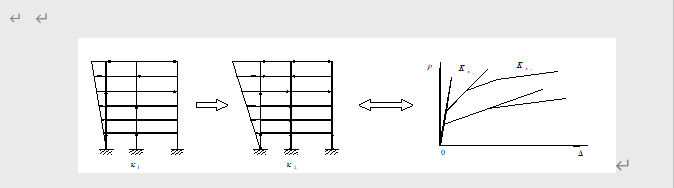
图3.2 非线性构形状态转移过程示意图
2.3.2 表 Tables
表应有自明性。表中参数应标明量和单位的符号。表一般随文排,先见相应文字,后见表。
Tables should be self-explanatory. Parameters in tables should indicate the quantity and unit symbols. Tables are generally placed with the text, with the corresponding text appearing before the table.
表序号与表题目:表序号即表的编号,由“表”和从“1”开始的阿拉伯数字组成,表较多时,可分章编号,如第三章第1个表的表序号为“表3.1”;表题目即表的名称,应简明,置于表序号之后,表序号和表题目之间空1个字距,居中置于表的上方。例如:
Table numbering and title: The table number is the table's identifier, consisting of "Table" and Arabic numerals starting from "1." When there are many tables, they can be numbered by chapter, such as the first table in Chapter 3 being numbered "Table 3.1." The table title is the name of the table, should be concise, and placed after the table number, with one space between the number and title, centered above the table. For example:
表3.1线性五杆结构各自由度随机反应数值特征
 (m) (m) |  |  |
均值(N) | 标准差(N) | 变异系数 | 均值(m) | 标准差(m) | 变异系数 |
0.000000 0.000100 0.000200 0.000300 | 0.000000 206.006806 412.013613 618.020419 | 0.000000 150.245905 215.100090 266.613296 | 0.000000 0.729325 0.522070 0.431399 | 0.000000 0.000024 0.000049 0.000073 | 0.000000 0.000013 0.000018 0.000022 | 0.000000 0.541667 0.367347 0.301370 |
2.3.3 表达式 Expressions
表达式主要指数字表达式,也包括文字表达式。如有两个以上的表达式,应用从“1”开始的阿拉伯数字进行编号,并将编号置于圆括号内。表达式的编号右端对齐。表达式较多时,可分章编号。如第三章第2个表达式:
Expressions primarily refer to numerical expressions, but also include textual expressions. If there are two or more expressions, they should be numbered using Arabic numerals starting from “1,” with the numbers placed inside parentheses. The expression numbers should be right-aligned. When there are numerous expressions, they can be numbered by chapter. For example, the second expression in Chapter 3:

2.4 参考文献 References
参考文献表的标注方法可采用顺序编码制,也可采用著者-出版年制。建议参照《文后参考文献著录规则》(GB/T 7714-2005)的要求书写参考文献,见附件11所示。
The citation method for the reference list can use either the sequential numbering system or the author-date system. It is recommended to follow the requirements of the 'Rules for the Compilation of References at the End of a Document' (GB/T 7714-2005) when writing the references. For more details, please refer to Appendix 11.
第3章 排版及印刷要求
Chapter 3: Layout and printing requirements
English font: Times New Roman
Chinese font: 宋体Size
3.1 纸张要求及页面设置Paper requirements and page setup
表3.1 纸张规格和页面设置要求
Table 3.1 Paper Specifications and Page Setting Requirements
| 排版要求Layout requirements |
| 纸 张paper | A4(210×297),幅面白色White format |
| 页面设置page setting | Up & down 3cm,left & right 3cm,header 2.5cm、footer 2.0cm,装订线binding line 0cm |
| 页 眉 header | Times New Roman 10.5 point in the middleAbstract 用 Times New Roman字体10.5 pointAbstract in Times New Roman font 10.5 points |
| 页 码 page number | Times New Roman 10.5 point |
3.2 中文封面排版要求 Chinese cover page layout requirements
中文封面已有固定版式,见附件11所示,只须提供有关内容。
The Chinese cover page has a fixed format, as shown in Appendix 11, only the relevant content needs to be provided.
表3.2中文封面排版要求
Table 3.2 Chinese cover page layout requirements
| 排版要求Layout requirements |
| 博士/硕士学位论文Doctoral/Master's dissertation | 宋体26point(或一号)加粗SimSun 26pt bold (or 一号) |
| 论文题目Thesis title | 黑体22point(或二号)加粗居中(可分两行),单倍行距SimHei 22pt bold(or 二号), centered (allowing for two lines if necessary), single spacing (English title should use Times New Roman) |
| 学 号Student number | Times New Roman体16point(或三号)加粗Times New Roman 16pt bold(or三号) |
| 论文作者Paper author | 宋体16point(或三号) 加粗SimSun 16pt bold (or三号) (English text should use Times New Roman) |
| 学科专业/企业导师Subject professional/business tutor | 宋体16point(或三号) 加粗SimSun 16pt bold (or三号) |
| 指导教师supervisor | 宋体16point(或三号) 加粗SimSun 16pt bold (or三号) |
| 培养单位training institution | 宋体16point(或三号) 加粗SimSun 16pt bold (or三号) |
| 日 期date | 宋体16point(或三号)汉字居中,不用阿拉伯数字SimSun 16 point(or三号) centered, do not use Arabic numerals |
3.4 中文题名页排版要求(见附件1)Chinese title page layout requirements (see Appendix 1)
表3.4 中文题名页排版要求
Table 3.4 Chinese title page layout requirements
| 学校代码institution code | 宋体16point(或三号)SimSun 16 point (or三号) |
| 研究生学号graduate student ID number | 宋体16point(或三号)居中SimSun 16 point (or三号) centered |
| 中国地质大学博士/硕士学位论文、硕士专业学位论文(全日制)/非全日制China University of Geosciences Doctoral/Master's dissertation, Master's professional dissertation (full-time)/part-time | 宋体26point(或一号)加粗 SimSun 26pt bold (一号) |
| 论文题目 Chinese title | 黑体22point(或二号)加粗居中(可分两行),单倍行距SimHei 22pt bold(or 二号), centered (allowing for two lines if necessary), single spacing |
| 学 号Student number | Times New Roman体16point(或三号) Times New Roman 16 point (or三号) |
| 论文作者Paper author | 宋体16point(或三号) SimSun 16 point (or三号) |
| 指导教师/企业导师Subject professional/business tutor | 宋体16point(或三号) SimSun 16 point (or三号) |
| 学科专业Subject specialty | 宋体16point(或三号) SimSun 16 point (or三号) |
| 培养单位training institution | 宋体16point(或三号) SimSun 16 point (or三号) |
| 日 期date | 宋体16point(或三号)汉字居中,不用阿拉伯数字SimSun 16 point(or三号) centered, do not use Arabic numerals |
3.5 英文题名页排版要求(见附件2)English title page layout requirements (see Appendix 2)
表3.5 英文题名页排版要求
Table 3.5 English title page layout requirements
| 英文排版要求English layout requirements |
| A Dissertation Submitted…… | Times New Roman 16point(or 三号) |
| Title | Times New Roman 22point bold(or 二号) centered, single spacing |
| Ph.D. Candidate: | Times New Roman 16point(or 三号)centered, single spacing |
| Major: | Times New Roman 16point(or 三号)centered, single spacing |
| Supervisor: | Times New Roman 16point(or 三号)centered |
| China Universiti of GeoscienceWuhan 430074P.R. China | Times New Roman 16point(or 三号)centered |
3.6 中、英文摘要排版要求 Chinese and English Abstract layout requirements
表3.6 中、英文摘要排版要求
Table 3.6 Chinese and English Abstract layout requirements
| 中文摘要排版要求Chinese | 英文摘要排版要求 English |
| 标题Title | 摘要:黑体18point(或小二)加粗居中,单倍行距SimHei 18pt bold(or 二号), centered, single spacing | Abstract: Times New Roman字体18point(或小二)加粗居中,单倍行距 Times New Roman 18pt bold(or 小二号), centered, single spacing |
| 段落Paragraphs文字Text | 宋体12point(或小四)固定值行距20point,段前段后0pointSimSun 12point(or 小四),fixed line spacing 20 points, before and after the segment 0 points | Times New Roman字体12point(或小四)固定值行距20point,段前段后0pointTimes New Roman 12point(or 小四)fixed line spacing 20 points, before and after the segment 0 points |
| 关键词Key words | “关键词”三字加粗宋体12point(或小四)Bold“关键词”SimSun 12point(or 小四) | “Key Words”两词加粗Times New Roman字体12point(或小四)Bold“Key Words”Times New Roman 12point(or小四) |
3.7 目录排版要求(见附件7)Contents layout requirement (see Appendix 7)
表3.7 目录排版要求
Table 3.7 Contents layout requirements
| 示例 Example | 排版要求 layout requirements |
| 标题Title | 目录 content | 黑体(英文用Times New Roman)16 point(或三号)加粗居中,单倍行距SimHei(English text should use Times New Roman) 16pt bold(or 三号), centered, single spacing |
| 各章目录Chapter List | 第一章格式要求×××Chapter 1 Format Requirements | 宋体(英文用Times New Roman)14 point(或四号), 固定值行距20 point,两端对齐,页码右对齐SimSun(English text should use Times New Roman), 14 point (or 四号), fixed line spacing at 20 point, justified alignment, page numbers right-aligned. |
| 一级节标题目录List of Level-One Section Titles | 1.5 ××× | 宋体(英文用Times New Roman) 12 point(或小四),固定值行距20 point,两端对齐,页码右对齐,左缩进1个汉字符 SimSun(English text should use Times New Roman), 12 point (or 小四), fixed line spacing at 20 point, justified alignment, page numbers right-aligned, with a left indent of one Chinese character width. |
| 二级节标题目录List of Level-Two Section Titles | 1.5.1 ××× | 宋体(英文用Times New Roman) 12 point(或小四),固定值行距20 point,两端对齐,页码右对齐,左缩进2个汉字符SimSun(English text should use Times New Roman), 12 point (or 小四), fixed line spacing at 20 point, justified alignment, page numbers right-aligned, with a left indent of two Chinese character width. |
3.8 正文排版要求 main body layout requirement(see Appendix 7)
表3.8 正文排版要求
Table 3.8 Formatting Requirements for the Main Body
| 示例 Example | 排版要求 layout requirements |
| 各章标题Chapter | 第一章×××Chapter 1 XXX | 黑体16 point(或三号)加粗居中,单倍行距,上下空2行,章序号与章题目间空一个汉字符SimHei, 16 point (or 三号), bold and centered, single line spacing, with two blank lines above and below, and a space of one Chinese character width between the chapter number and the chapter title. |
| 一级节标题1.1Level-One Section Titles 1.1 | 1.1 ××× | 黑体14 point(或四号)加粗居中,单倍行距,上下空1行,序号与题名之间空一个汉字符SimHei, 14 point (or 四号), bold and centered, single line spacing, with one blank line above and below, and a space of one Chinese character width between the number and the title. |
| 二级节标题1.1.1Level-Two Section Titles1.1.1 | 1.1.1 ××× | 黑体12 point(或小四)居左,单倍行距,上下空1行,序号与题名之间空一个汉字符。 SimHe, 12 point (or 小四), left-aligned, single line spacing, with one blank line above and below, and a space of one Chinese character width between the number and the title. |
| 正文段落文字Main Body | ××××××××××××××××××××××× | 宋体12 point(或小四),英文用Times New Roman字体12 point(或小四),两端对齐书写,段落首行左缩进2个汉字符。固定值行距20point(段落中有数学表达式时,可根据表达需要设置该段的行距),段前0point,段后0point。For Chinese text: SimSun, 12 point (or Size 5); for English text: Times New Roman, 12 point (or Size 5). Justified alignment, with an indentation of two Chinese character widths at the beginning of each paragraph. Fixed line spacing at 20 point (if there are mathematical expressions in the paragraph, the line spacing may be adjusted according to the expression's needs). Paragraph spacing: 0 point before and 0 point after. |
| 图序号、图名Figure Number, Figure Title | 图2.1 ×××Figure 2.1 ××× | 置于图的下方,宋体10.5point(或五号)居中,单倍行距,图序号与图题目文字之间空一个汉字符宽度。Placed below the figure, SimSun, 10.5 point (or 五号), centered, single line spacing, with a space of one Chinese character width between the figure number and the figure title text. |
| 表序号、表名Table Number, Table Title | 表3.1 ×××Table 3.1 ××× | 置于表的上方,宋体10.5point(或五号)居中,单倍行距,表序号与表题目文字之间空一个汉字符宽度。Placed above the table, SimSun, 10.5 point (or 五号), centered, single line spacing, with a space of one Chinese character width between the table number and the table title text. |
| 表达式Expression | ……(3.2) | 序号加圆括号,Times New Roman10.5point(或五号),右对齐。The number is enclosed in parentheses, Times New Roman, 10.5 point (or 五号), right-aligned. |
3.9 其他部分排版要求
表3.9 其他部分排版要求
Table 3.9 Formatting Requirements for Other Sections
| 排版要求 Formatting Requirements |
| 作者简介Author’s Resume | 标题要求同各章标题,正文部分宋体12point(或小四),行距20point,段前段后0point。The title requirements are the same as those for chapter titles. The main text should be in SimSun(English text should use Times New Roman), 12 point (or Size 小四), with a line spacing of 20 point. Paragraph spacing should be 0 point before and 0 point after. |
| 致谢Acknowledgment | 标题要求同各章标题,正文部分宋体12point(或小四),行距20point,段前段后0point。The title requirements are the same as those for chapter titles. The main text should be in SimSun(English text should use Times New Roman), 12 point (or Size 小四), with a line spacing of 20 point, and paragraph spacing of 0 point before and after. |
| 参考文献Reference | 标题要求同各章标题,正文部分:宋体12point(或小四,英文用Times New Roman字体12point),行距20point,段前段后0point。The title requirements are the same as those for chapter titles. For the main text: SimSun, 12 point (or 小四; English text should use Times New Roman, 12 point), with a line spacing of 20 point, and paragraph spacing of 0 point before and after. |
| 附录Attachment if you have | 标题要求同各章标题,正文部分:宋体12point(英文用Times New Roman字体12point),两端对齐书写,段落首行左缩进2个汉字符。行距20point(段落中有数学表达式时,可根据表达需要设置该段的行距),段前0point,段后0point。The title requirements are the same as those for chapter titles. The main text should be in SimSun, 12 point (English text should use Times New Roman, 12 point), with justified alignment, and the first line of each paragraph indented by two Chinese characters. Line spacing should be 20 point (for paragraphs containing mathematical expressions, the line spacing may be adjusted according to the expression’s needs), with 0 point before and after the paragraph. |
3.10 论文印刷及装订要求 Requirements for Thesis Printing and Binding
论文自中文摘要起双面印刷,之前部分单面印刷。如果论文因页码过少而不能印刷书脊时,可以单面印刷。
根据论文存档要求,论文必须用线装或热胶装订,不能使用金属钉装订。
Starting from the Chinese abstract, the thesis shall be printed double‑sided. All preceding pages shall be printed single‑sided. If the total number of pages is too few to produce a book spine, single‑sided printing is acceptable.
In accordance with thesis archiving requirements, the thesis must be bound using thread binding or thermal glue binding. Metal stapling is not permitted.
Attention: The yellow parts in Appendix are for your reference, so remember to remove them in your thesis!