On 7 November, the second-quarter 2026 data quality assessment report of the Dizhi-1 (Geology-1) hyperspectral remote sensing satellite and a new batch of sample data were released at the opening of the 14th University GIS Forum.
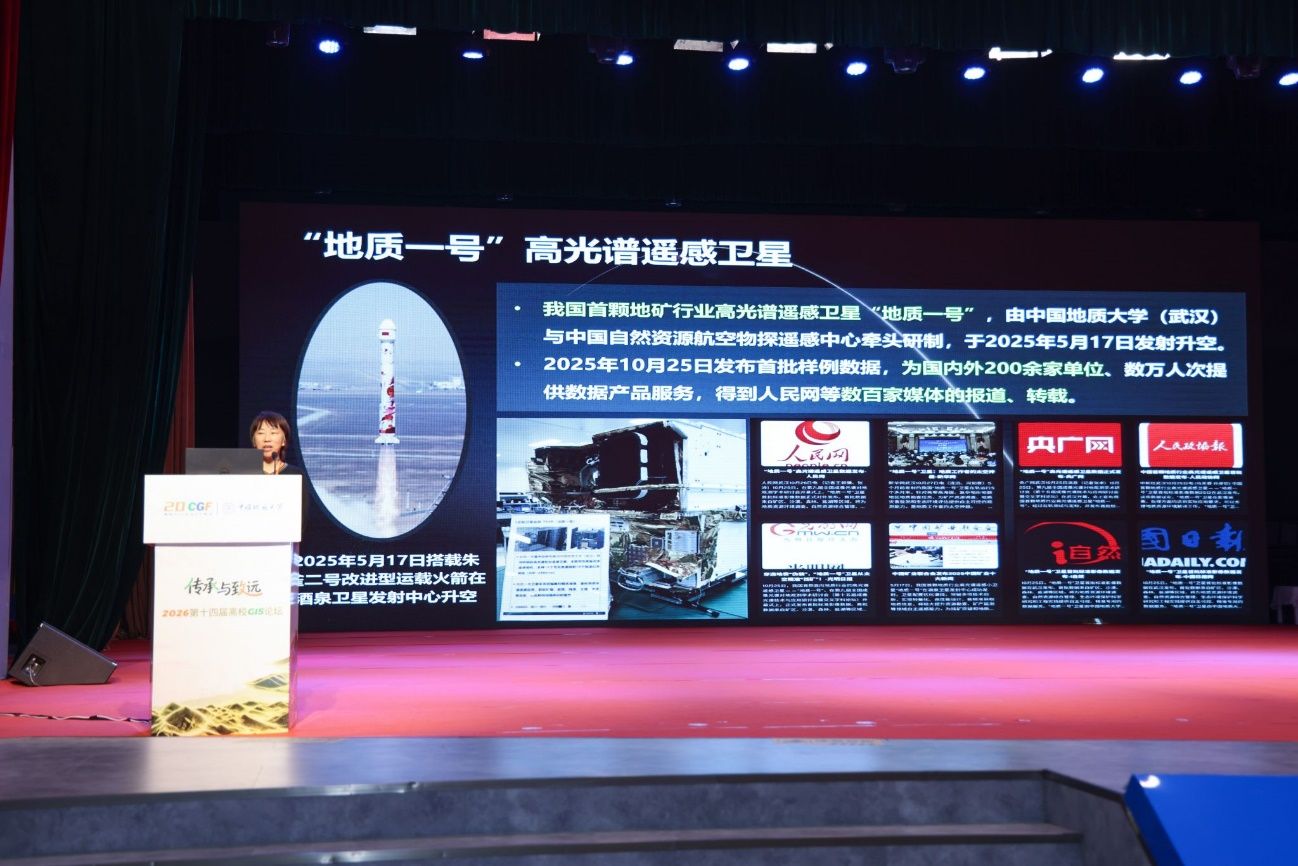
As of 31 October 2026, the satellite had downlinked data over more than 1,100 orbits, accumulated more than 8 TB, acquired over 17,000 scenes and flown about 350 million km. It has supplied data products to more than 200 institutions in China and abroad, and supported research on intelligent mineral prospectivity prediction and reserve-increase demonstration in Central Asia and Xinjiang Province.
The assessment drew on cloud-free imagery acquired in the second quarter of 2026 and applied national and international standards to 12 indicators across four dimensions: radiometric, spatial, spectral and geometric. Experts from multiple institutions in the sector took part in the review. The panel concluded unanimously that the satellite's data are of internationally leading quality overall, with signal-to-noise ratio, full-field-of-view uniformity, radiometric stability, RMS striping and banding, image edge slope and consistency of surface reflectance trends on par with advanced international satellites.
The sample data are free for research and education. Data can be downloaded from service portal (www.geosat.com.cn), then loaded through the ENVI extension "China Domestic Satellite Support Tool" to identify product metadata and organize bands automatically, supporting geological resource and environmental exploration and monitoring as well as related research.
The report and the data release further verify the satellite's in-orbit capability to acquire hyperspectral data and deliver high-quality data services, and demonstrate CUG's technical strength in satellite development, data processing and application services. It has been reported by People's Daily Online and hundreds of other media outlets, and were named among China's Top 10 Mining News of 2025, Hubei's Top 10 Scientific and Technological Advances of 2025 and the Top 10 Events in Remote Sensing of 2025. The work appeared on the cover of the first 2026 issue of National Remote Sensing Bulletin and won a gold medal at the 2025 Geneva International Exhibition of Inventions.
Contributed by “CUG News”