1. 问:国际学生研究生各阶段应该完成什么学习任务?
Q: What study tasks should the international PhD students at CUG complete at each stage of postgraduate study?
学习阶段 Study Stage | 博士 | PhD |
学习要求 | Study Tasks |
第一学期 1st Semester | 公选课应修8个学分, 专业课6个学分,累计学分≥14 | 8 credits for public courses, 6 credits for specialized courses,with the total credits≥14 |
第二学期 2nd Semester | 公选课应修9个学分,专业课4个学分(学科前沿)&实验研究,累计学分≥27 | 9 credits for public courses,4 credits for specialized courses(academic frontiers)& experimental research,with the total credits ≥27 |
第三学期 3rd Semester | 论文开题&文献综述(6个学分), 累计学分≥33 | Thesis Proposal & Literature Review(6 credits),total credits≥33 |
第四学期 4th Semester | 中期考核&论文研究 | Mid-term assessment & Thesis Research & Writing first paper |
第五学期 5th Semester | 论文研究 | Thesis Research |
第六学期 6th Semester | 论文研究 | Thesis Research & Writing second paper |
第七学期 7th Semester | 论文研究&预答辩 | Thesis Research & Pre-defense |
第八学期 8th Semester | 盲审&答辩&毕业 | Blind Review & Defense & Graduation |
2. 问:博士研究生申请学位需要达到什么学术要求?
Q: What academic requirements for doctoral candidates to apply for degrees are at CUG?
答:为保证我校博士研究生的培养质量,提高学术水平和创新能力,经校学位评定委员会讨论通过,对博士研究生申请学位时需达到的学术成果作如下要求:
在中国地质大学(武汉)期刊分类中T3及以上级别的期刊发表学术论文1篇;或在T4期刊上发表学术论文2篇;或获得授权的国际发明专利1项,或国家发明专利2项。
对于博士而言,如以后计划申请博士后或找工作,必须要发表相应的高水平学术成果。在学术论文撰写过程中,应严格遵守学术道德,不得剽窃他人学术成果,不能侵犯他人知识产权。研究生在学期间公开发表学术论文前,必须要通过导师的审核同意,未经导师审核同意公开发表的学术论文,不得用于评奖、评优、申报各类项目和学位论文成果要求。
中国政府奖学金研究生的学术论文在发表时,需在文章的致谢中注明“本论文得到中国政府奖学金资助”。发表的学术论文需同时标注出专业所在学院及丝绸之路学院。
A: In order to ensure the cultivation quality of PhD students at CUG and improve their academic level and innovation ability, through discussion and approval by the Academic Degree Assessment Committee of CUG, the following requirements are made for the academic achievements of PhD students when applying for a PhD degree:
·Published 1 academic paper in journals with T3 or above in the Journal Classification of CUG;
·publish 2 academic papers on T4 journals;
·Obtain 1 authorized international invention patent or 2 national invention patents.
For PhD student, if you plan to apply for postdoctor or find a job in the future, you must publish corresponding high-level academic papers. In the process of writing academic papers, academic ethics should be strictly observed, academic achievements of others should not be plagiarized, and the intellectual property rights of others should not be infringed. Graduate students must pass the review and approval of your supervisor before publishing your academic papers during the study period. Academic papers published without the review and consent of your supervisor shall not be used for evaluations and application for various projects and dissertation achievement requirements.
Students of Chinese Government Scholarship, when your academic papers are published, please mention that “This paper is supported by the Chinese Government Scholarship” in the acknowledgement. In the published academic papers, your college and the Silk Road Institute need to be marked simultaneously.
中国地质大学(武汉)各学科期刊分类目录(2023版) CUG Academic Journal and Paper Classification Guide
Link: https://eniec.cug.edu.cn/High_level_Academic_Papers/CUG_Academic_Journal_and_Paper_Classification_Gu.htm
中国地质大学(武汉)国际学生发表的高水平学术论文 High-level Academic Papers Published by CUG international Students(T1&T2)
Link: https://eniec.cug.edu.cn/High_level_Academic_Papers/Academic_Papers_Published_by_CUG_international_S.htm
追求学术卓越是中国地质大学的核心价值!
Pursuing academic excellence is the core value of CUG!
3. 问:如何制定个人学习计划?
Q: How to make a Personal Study Plan at CUG?
答:国际学生研究生请在入学一周之内联系本学院辅导员,进入学院学生群,获取培养方案,联系导师制订个人学习计划。导师是研究生培养的第一责任人,研究生阶段的学习应加强与导师的沟通交流,尽快融入到导师的团队中,进入到导师的实验室,坚持以导师为中心的原则。
研究生培养方案及课表下载地址:https://iec.cug.edu.cn/jyjx/yjsjy.htm
资源学院、环境学院、经管学院、公管学院英文项目班的课表将会在每个学期开学后一个月内单独通知。
A: International graduate students should contact the tutor of the college within one week of enrollment to enter the student group of your respective school, obtain the training program, and contact the supervisor to formulate a personal study plan. The supervisor is responsible for the process of training of graduate students, so graduate students should adhere to the principle of supervisor-centered, strengthen study communication with the supervisor, integrate into supervisor’s team as soon as possible, go to the supervisor’s laboratory every day.
Download address of graduate training program and course schedules:https://iec.cug.edu.cn/jyjx/yjsjy.htm
The course schedules for the English program classes of the School of Earth Resources, School of Environmental Studies, School of Economics and Management, and School of Public Administration will be announced separately within one month after the start of each semester.
4. 问:如何看懂研究生课表?
Q: How to read the Course Schedule at CUG?
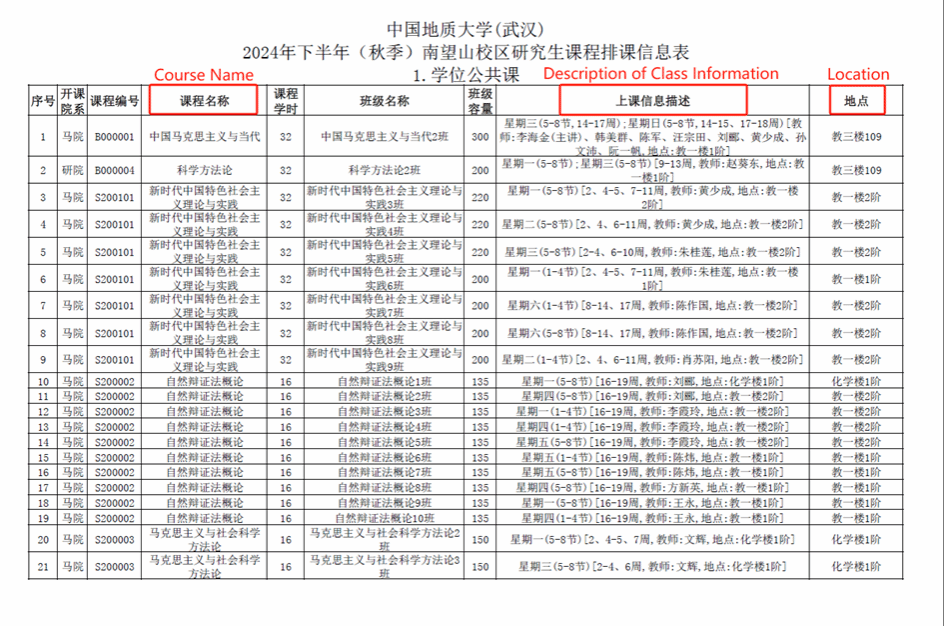
1) 课程名称-Course Name
根据培养方案制定每学期所学课程,在课表-课程名称栏目中找到相应的课程。
Formulate the courses to be learned each semester according to the training plan, and find the corresponding courses in the class schedule-course name column.
2) 上课信息描述- Description of Class Information
课表第8列和第9列为上课时间地点相关信息,包括上课时间、上课周、授课教师姓名及上课地点。
以《科学方法论》这门课为例,这门课程开设的时间是教学日历上的第9-13周,每周的星期一(5-8节)和星期三(5-8节),上课地点在教一楼1阶。
Columns 8 and 9 of the Timetable provide information about the time and location of the class, including the time, the week, teacher’s name and the location of the class.
Take the course "Scientific Methodology" as an example, this course is held from the ninth to the thirteenth week of the teaching calendar, every Monday (Class5-8) and Wednesday (Class5-8), at the first step classroom of the No.1 teaching building.
上课时间- Time of Class:
南望山校区(5 月 1 日—9 月 30 日) Nanwangshan Campus(May. 1st-Sep. 30th) |
课节Period | 开始时间Begin | 结束时间End |
1-2 | 8:00 | 9:35 |
3-4 | 10:05 | 11:40 |
5-6 | 14:30 | 16:05 |
7-8 | 16:35 | 18:10 |
9-10 | 19:30 | 21:05 |
南望山校区(10月 1 日—4月 30 日) Nanwangshan Campus(Oct. 1st-Apr. 30th ) |
课节Period | 开始时间Begin | 结束时间End |
1-2 | 8:00 | 9:35 |
3-4 | 10:05 | 11:40 |
5-6 | 14:00 | 15:35 |
7-8 | 16:05 | 17:40 |
9-10 | 19:00 | 20:35 |
未来城校区Future City Campus |
课节Period | 开始时间Begin | 结束时间End |
1-2 | 8:30 | 10:05 |
3-4 | 10:15 | 11:50 |
5-6 | 14:00 | 15:35 |
7-8 | 15:45 | 17:20 |
9-10 | 18:30 | 20:05 |
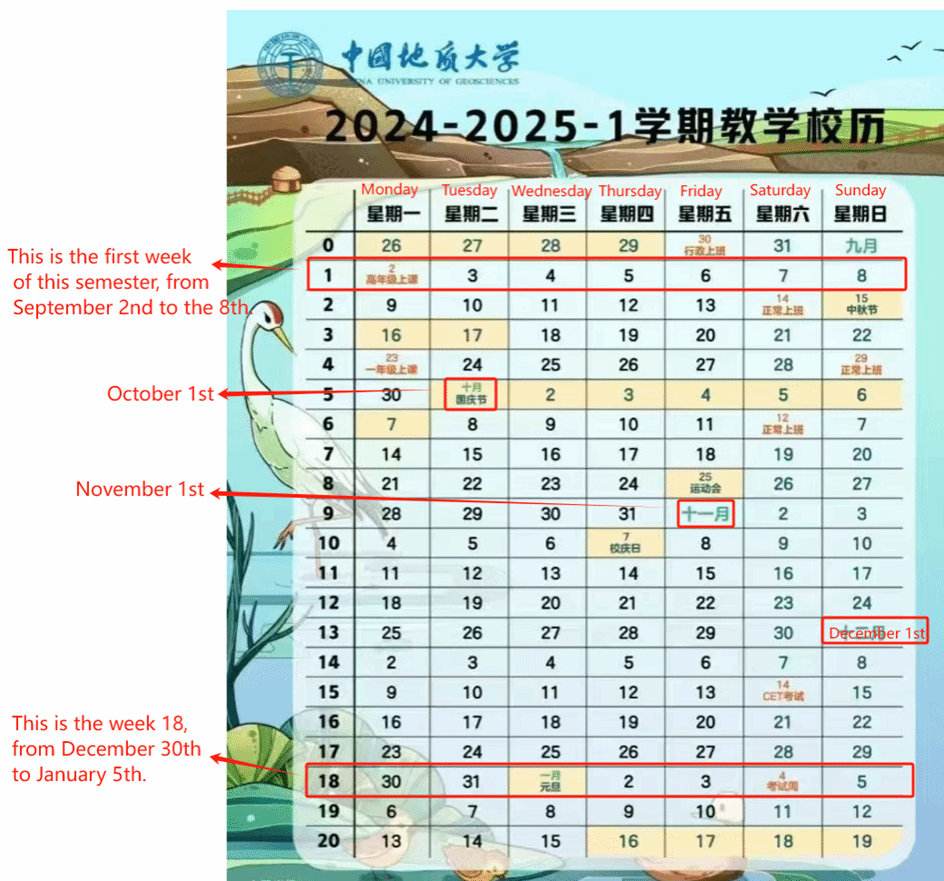
上课周:根据教学日历可查看当前属于第几周
Class Week: According to the Teaching Calendar of CUG, you can check the current week.
示例为 2024-2025-1 学期教学校历,第 1 周为 9 月 2 日 - 8 日,第 18 周为 12 月 30 日 - 1 月 5 日。
The example provided is the Teaching Calendar for the 2024-2025-1 Semester. Week 1 spans from September 2 to September 8, and Week 18 spans from December 30 to January 5.
5. 问:国际学生的上课流程是什么?
Q: What is the international student's class process at CUG?
附二维码:国际学生上课流程(学历生)International Students’ Attendance Process (For Degree Students)
6. 问:如何查询国际学生成绩单?
Q: How to check international student transcripts at CUG?
附二维码:如何查询成绩-How to check scores in system
7. 问:国际学生博士论文开题和毕业答辩需要注意些什么时间节点呢?
Q: What time nodes do you need to pay attention to the thesis proposal and graduation defense at CUG?
答:国际学生博士生开题与毕业答辩间隔时间须满12个月,否则不允许申请答辩。国际学生开题不需要在研究生管理信息系统进行登记,开题答辩由导师负责组织安排,开题答辩通过后,需提交一份签字盖章的开题报告登记表给学院研究生教学秘书,同时提交一份复印件至国际教育学院223办公室存档。
开题报告登记表下载地址:https://iec.cug.edu.cn/lhlx/bgxz.htm
A: The interval between the PhD's proposal and the graduation defense must be at least 12 months, otherwise it is not allowed to apply graduation defense.
International students’ thesis proposal do not need to register in the postgraduate management information system. The proposal defense is organized by the supervisor. After passing the proposal defense, please submit the thesis proposal registration form with panel members’ signatures and school seal to the department secretary and submit a copy to office 223.
Download address of the thesis proposal registration form: https://iec.cug.edu.cn/lhlx/bgxz.htm
8. 问:国际学生博士生是否需要参加学位论文盲审?
Q: Are international PhD students required to undergo the blind review before defense at CUG?
答:国际学生博士生必须参加学位论文盲审。博士学位论文盲审工作由国际教育学院组织实施,委托教育部学位与研究生教育发展中心“学位论文质量检查服务平台”进行,该平台属于国家级检测平台,对于学位论文的要求非常严格,请大家务必引起重视。
学位论文盲审是毕业流程的重要环节,盲审不通过的将无法申请毕业答辩。首次盲审不通过的,可由博士生在六个月或一年内修改论文,重新送审一次。若第二次送审仍未通过的,博士学位论文须重新开题、重新撰写,重新开题一年后方可再次申请盲审。
A: International PhD students are required to participate in the blind review of the dissertation. The blind review of the dissertation is organized by each college and entrusted to "Dissertation Quality Inspection Service Platform" of China Academic Degrees and Graduate Education Development Center (CDGDC), which is a national testing platform and has very strict requirements for the evaluation of dissertations, so please attach great importance to it.
Blind review is a key part of the graduation process. Students who fail the blind review are not eligible to apply for graduation defense:
First failure: Students may revise the thesis within 6 months to 1 year and resubmit it for review;
Second failure: Students must re-conduct the thesis proposal and rewrite the thesis. They can apply for blind review again only 1 year after the second thesis proposal.
9. 问:如何申请休学/复学、退学/转学、转专业/导师、提前毕业等学籍异动。
Q: How to apply for suspension/resuming, quit/transfer, change of major/supervisor, early graduation and other changes in student status at CUG?
附二维码:国际学生学籍异动流程(学历生)International Students’ Enrollment Status Change Process (For Degree Students)
10. 问:国际学生的毕业流程是什么?
Q: What is the international student's graduation process at CUG?
附二维码:国际学生毕业流程(研究生)International Students’ Graduation Process (For Graduate Students)
11. 问:国际学生研究生督学卡是什么?
Q: What is the international Postgraduate Academic Supervision Card at CUG?
答:研究生阶段学习导师指导具有重要作用,在充分调研和收集我校国际学生研究生培养现状的基础上,学院针对硕博研究生启动“研究生学业督学计划”,为每个研究生建档立卡发放《国际学生硕士研究生学业督学记录卡》和《国际学生博士研究生学业督学记录卡》(以下简称《记录卡》),以督促国际学生研究生积极融入导师团队,根据导师指导按时完成学业,旨在对国际学生培养质量的全过程进行有效监控,是将国际学生学业的关键因素和培养过程中的阶段性关键环节始终置于受控状态,通过督学进一步在国际学生培养管理过程中强化刚性约束,保障国际学生研究生培养质量。
《记录卡》每学期国际学生人手一本,并对各阶段学习任务做了明确标识,对与导师交流情况、融入导师团队、进入实验室研究等方面做了明确的量化和清晰的说明。国际教育学院对记录卡中学生与导师交流情况进行月督查,教务办公室对记录卡中每学期学业完成情况进行阶段性督查,记录卡每学期交国际教育学院回收存档。
A: The guidance of supervisor is important for postgraduate student. On the basis of fully investigating and collecting the current training status of postgraduate students at CUG, international office starts “Postgraduate Academic Supervision Program”, and issues “Study Inspection Record for International Master Students” and “Study Inspection Record for International PhD Students” (Record Card) to promote the active integration of international postgraduate students into the supervisor’s team and the timely completion of their academic studies according to the supervisor's guidance.
The “Postgraduate Academic Supervision Program” is made to effectively monitor the whole process of international student training quality, and to put the key factors of international students’ studies and the key links in the training process under control, and to further strengthen the rigid constraints in the process of international student training management through supervision, so as to ensure the training quality of international postgraduate students. Each international postgraduate student has a record for each semester, which clearly identifies the learning tasks at each stage, and quantifies and explains the communication with the supervisor, the integration into the supervisor’s team, and the research into the laboratory. International Education College shall conduct monthly supervision of the communication between students and supervisors in the inspection record. The Study Affairs Office shall conduct periodic supervision of the academic completion of each semester in the inspection record, and the record card shall be collected and archived every semester.
12. 问:为什么研究生必须参加《丝路讲坛》和《丝路博士讲坛》?
Q: Why do postgraduate students must attend the Silk Road Form and Silk Road Doctor Forum?
答:中国地质大学(武汉)坚持以学术理念为主导价值,追求“学术卓越”国际教育学院实施“国际学生学术能力提升工程”,搭建《丝路讲坛》和《丝路博士讲坛》,每期聚焦国际学生核心学术困惑,每月两期,是国际学生研究生的必修讲座。
A: As “Double World-Class Project” university, CUG adheres to the academic philosophy as the dominant value and pursues “academic excellence”. To effectively implement “The Project of Improving the Academic Ability of International Students”, International Education College builds platforms of the “Silk Road Forum” and “Silk Road Doctor Forum” , which is are held twice a month and created as compulsory lectures that focus on the core academic confusion of international students.